
Maximize the Number of Target Nodes After Connecting Trees II
There exist two undirected trees with n and m nodes, labeled from [0, n - 1] and [0, m - 1], respectively.
You receive two 2D integer arrays edges1 and edges2 of lengths n - 1 and m - 1, respectively, where edges1[i] = [a i, b i ] indicates that there is an edge between nodes a i and b i in the first tree and edges2[i] = [u i, v i ] indicates that there is an edge between nodes u i and v i in the second tree.
Node u is target to node v if the number of edges on the path from u to v is even. Note that a node is always target to itself.
Produce an array of n integers answer, where answer[i] is the maximum possible number of nodes that are target to node i of the first tree if you had to connect one node from the first tree to another node in the second tree.
Note that queries are independent from each other. That is, for every query you will remove the added edge before proceeding to the next query.
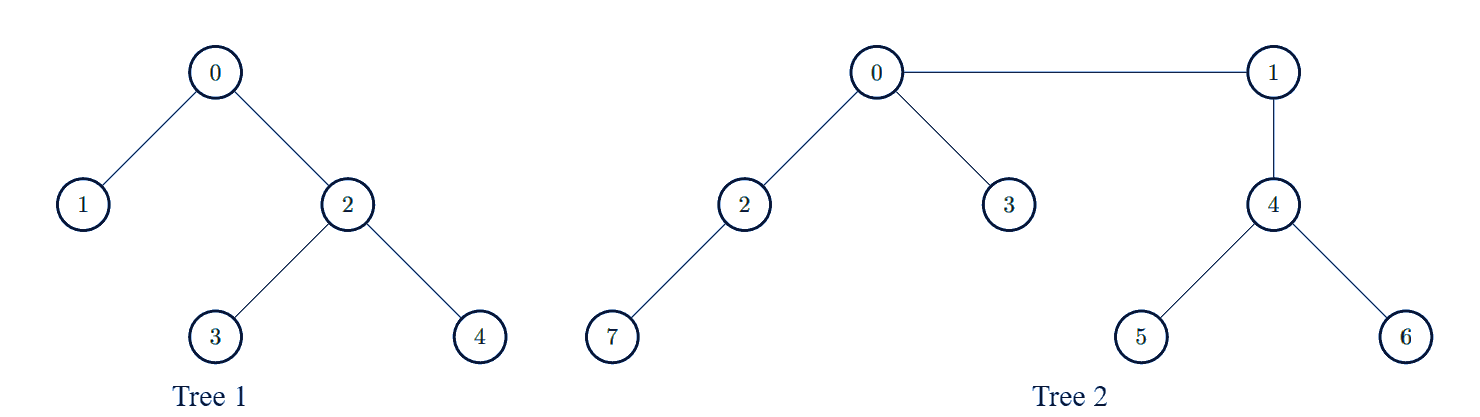
Input: edges1 = [[0,1],[0,2],[2,3],[2,4]], edges2 = [[0,1],[0,2],[0,3],[2,7],[1,4],[4,5],[4,6]]
Output: [8,7,7,8,8]
Explanation:
-
For
i = 0, connect node 0 from the first tree to node 0 from the second tree. -
For
i = 1, connect node 1 from the first tree to node 4 from the second tree. -
For
i = 2, connect node 2 from the first tree to node 7 from the second tree. -
For
i = 3, connect node 3 from the first tree to node 0 from the second tree. -
For
i = 4, connect node 4 from the first tree to node 4 from the second tree.
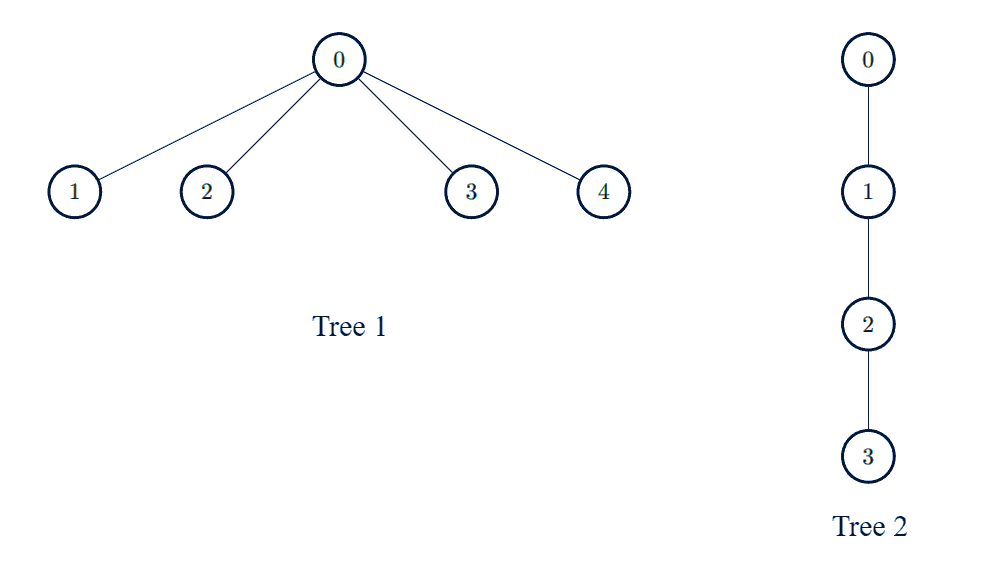
Input: edges1 = [[0,1],[0,2],[0,3],[0,4]], edges2 = [[0,1],[1,2],[2,3]]
Output: [3,6,6,6,6]
Explanation: For every i, connect node i of the first tree with any node of the second tree.
Constraints
2 <= n, m <= 10^5edges1.length == n - 1edges2.length == m - 1edges1[i].length == edges2[i].length == 2edges1[i] = [a i, b i ]0 <= a i, b i < nedges2[i] = [u i, v i ]0 <= u i, v i < m- The input is generated such that
edges1andedges2represent valid trees.
Did this problem appear in one of your interviews?
Responses stay private.