
Maximum Number of K-Divisible Components
There is an undirected tree with n nodes labeled from 0 to n - 1. You receive the integer n and a 2D integer array edges of length n - 1, where edges[i] = [a i, b i ] indicates that there is an edge between nodes a i and b i in the tree.
You are also provided a 0-indexed integer array values of length n, where values[i] is the value associated with the i th node, and an integer k.
A valid split of the tree is obtained by removing any set of edges, possibly empty, from the tree such that the resulting components all have values that are divisible by k, where the value of a connected component is the sum of the values of its nodes.
Produce the maximum number of components in any valid split.
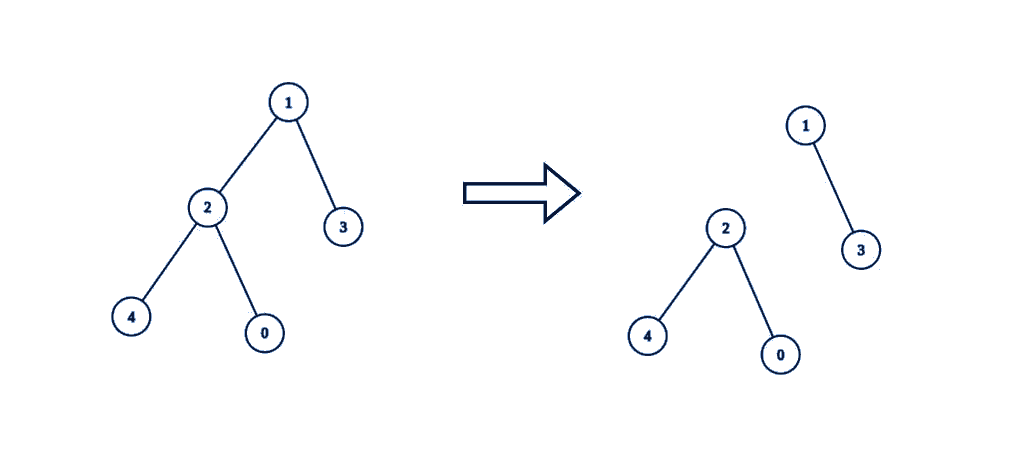
Input: n = 5, edges = [[0,2],[1,2],[1,3],[2,4]], values = [1,8,1,4,4], k = 6
Output: 2
Explanation: We remove the edge connecting node 1 with 2. The resulting split is valid because:
-
The value of the component containing nodes 1 and 3 is values[1] + values[3] = 12.
-
The value of the component containing nodes 0, 2, and 4 is values[0] + values[2] + values[4] = 6.
It can be shown that no other valid split has more than 2 connected components.
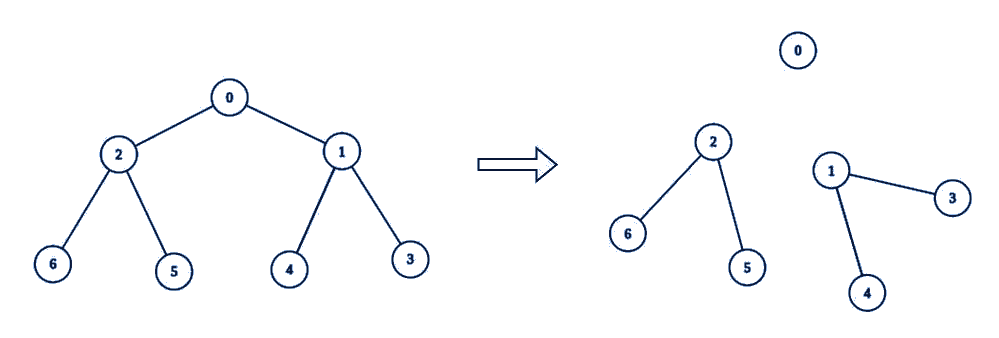
Input: n = 7, edges = [[0,1],[0,2],[1,3],[1,4],[2,5],[2,6]], values = [3,0,6,1,5,2,1], k = 3
Output: 3
Explanation: We remove the edge connecting node 0 with 2, and the edge connecting node 0 with 1. The resulting split is valid because:
-
The value of the component containing node 0 is values[0] = 3.
-
The value of the component containing nodes 2, 5, and 6 is values[2] + values[5] + values[6] = 9.
-
The value of the component containing nodes 1, 3, and 4 is values[1] + values[3] + values[4] = 6.
It can be shown that no other valid split has more than 3 connected components.
Constraints
1 <= n <= 3 * 10^4edges.length == n - 1edges[i].length == 20 <= a i, b i < nvalues.length == n0 <= values[i] <= 10^91 <= k <= 10^9- Sum of
valuesis divisible byk. - The input is generated such that
edgesrepresents a valid tree.
Did this problem appear in one of your interviews?
Responses stay private.