
Maximum Square Area by Removing Fences From a Field
There is a large (m - 1) x (n - 1) rectangular field with corners at (1, 1) and (m, n) containing some horizontal and vertical fences given in arrays hFences and vFences respectively.
Horizontal fences are from the coordinates (hFences[i], 1) to (hFences[i], n) and vertical fences are from the coordinates (1, vFences[i]) to (m, vFences[i]) .
Produce the maximum area of a square field that can be formed by removing some fences ( possibly none ) or -1 if it is imvalid to make a square field .
Since the answer may be large, produce it modulo 10^9 + 7 .
Note: The field is surrounded by two horizontal fences from the coordinates (1, 1) to (1, n) and (m, 1) to (m, n) and two vertical fences from the coordinates (1, 1) to (m, 1) and (1, n) to (m, n) . These fences cannot be removed.
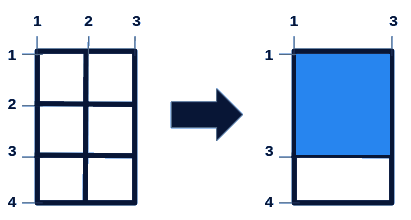
Input: m = 4, n = 3, hFences = [2,3], vFences = [2]
Output: 4
Explanation: In this case, removing the horizontal fence at 2 and the vertical fence at 2 will give a square field of area 4.
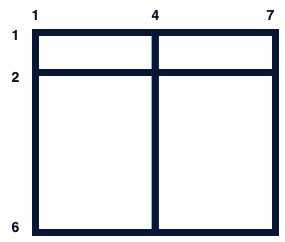
Input: m = 6, n = 7, hFences = [2], vFences = [4]
Output: -1
Explanation: In this case, it can be proved that there is no way to create a square field by removing fences.
Constraints
3 <= m, n <= 10^91 <= hF ences .length, vFences.length <= 6001 < hFences[i] < m1 < vFences[i] < nhFencesandvFencesare unique.
Did this problem appear in one of your interviews?
Responses stay private.