
Minimum Operations to Make a Uni-Value Grid
Medium
You receive a 2D integer grid of size m x n and an integer x . In one operation, you can add x to or subtract x from any element in the grid .
A uni-value grid is a grid where all the elements of it are equal.
Produce the minimum number of operations to make the grid uni-value . If it is not possible, return -1 .
Example 1
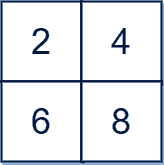
Input: grid = [[2,4],[6,8]], x = 2
Output: 4
Explanation: We can make every element equal to 4 by doing the following:
-
Add x to 2 once.
-
Subtract x from 6 once.
-
Subtract x from 8 twice.
A total of 4 operations were used.
Example 2
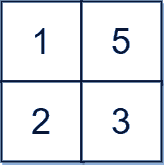
Input: grid = [[1,5],[2,3]], x = 1
Output: 5
Explanation: We can make every element equal to 3.
Example 3
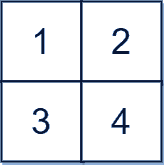
Input: grid = [[1,2],[3,4]], x = 2
Output: -1
Explanation: It is impossible to make every element equal.
Constraints
m == grid.lengthn == grid[i].length1 <= m, n <= 10^51 <= m * n <= 10^51 <= x, grid[i][j] <= 10^4
Did this problem appear in one of your interviews?
Responses stay private.