
Minimum Score After Removals on a Tree
There is an undirected connected tree with n nodes labeled from 0 to n - 1 and n - 1 edges.
You receive a 0-indexed integer array nums of length n where nums[i] represents the value of the i th node. You are also given a 2D integer array edges of length n - 1 where edges[i] = [a i, b i ] indicates that there is an edge between nodes a i and b i in the tree.
Remove two distinct edges of the tree to form three connected components. For a pair of removed edges, the following steps are defined:
-
Get the XOR of all the values of the nodes for each of the three components respectively.
-
The difference between the largest XOR value and the smallest XOR value is the score of the pair.
- For example, say the three components have the node values:
[4,5,7],[1,9], and[3,3,3]. The three XOR values are4 ^ 5 ^ 7 = 6,1 ^ 9 = 8, and3 ^ 3 ^ 3 = 3. The largest XOR value is8and the smallest XOR value is3. The score is then8 - 3 = 5.
Produce the minimum score of any possible pair of edge removals on the given tree.
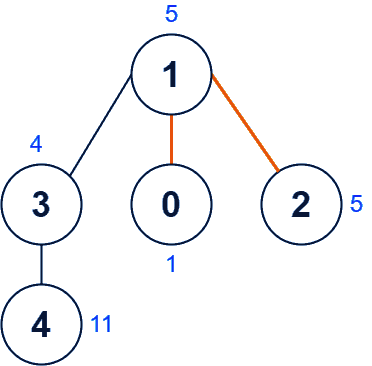
Input: nums = [1,5,5,4,11], edges = [[0,1],[1,2],[1,3],[3,4]]
Output: 9
Explanation: The diagram above shows a way to make a pair of removals.
-
The 1st component has nodes [1,3,4] with values [5,4,11]. Its XOR value is 5 ^ 4 ^ 11 = 10.
-
The 2nd component has node [0] with value [1]. Its XOR value is 1 = 1.
-
The 3rd component has node [2] with value [5]. Its XOR value is 5 = 5.
The score is the difference between the largest and smallest XOR value which is 10 - 1 = 9.
It can be shown that no other pair of removals will obtain a smaller score than 9.
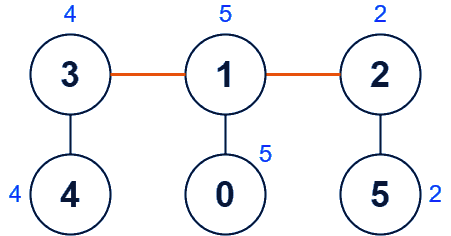
Input: nums = [5,5,2,4,4,2], edges = [[0,1],[1,2],[5,2],[4,3],[1,3]]
Output: 0
Explanation: The diagram above shows a way to make a pair of removals.
-
The 1st component has nodes [3,4] with values [4,4]. Its XOR value is 4 ^ 4 = 0.
-
The 2nd component has nodes [1,0] with values [5,5]. Its XOR value is 5 ^ 5 = 0.
-
The 3rd component has nodes [2,5] with values [2,2]. Its XOR value is 2 ^ 2 = 0.
The score is the difference between the largest and smallest XOR value which is 0 - 0 = 0.
We cannot obtain a smaller score than 0.
Constraints
n == nums.length3 <= n <= 10001 <= nums[i] <= 10^8edges.length == n - 1edges[i].length == 20 <= a i, b i < na i != b iedgesrepresents a valid tree.
Did this problem appear in one of your interviews?
Responses stay private.