
Reschedule Meetings for Maximum Free Time I
You receive an integer eventTime denoting the duration of an event, where the event occurs from time t = 0 to time t = eventTime .
You are also given two integer lists startTime and endTime , each of length n . These represent the start and end time of n non-overlapping meetings, where the i^th meeting occurs during the time [startTime[i], endTime[i]] .
You can reschedule at most k meetings by moving their start time while maintaining the same duration , to maximize the longest continuous period of free time during the event.
The relative order of all the meetings should stay the same and they should remain non-overlapping.
Produce the maximum amount of free time possible after rearranging the meetings.
Note that the meetings can not be rescheduled to a time outside the event.
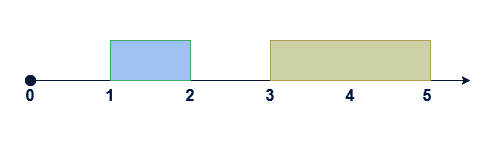
Input: eventTime = 5, k = 1, startTime = [1,3], endTime = [2,5]
Output: 2
Explanation: Reschedule the meeting at [1, 2] to [2, 3] , leaving no meetings during the time [0, 2] .
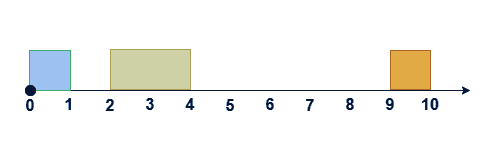
Input: eventTime = 10, k = 1, startTime = [0,2,9], endTime = [1,4,10]
Output: 6
Explanation: Reschedule the meeting at [2, 4] to [1, 3] , leaving no meetings during the time [3, 9] .
Input: eventTime = 5, k = 2, startTime = [0,1,2,3,4], endTime = [1,2,3,4,5]
Output: 0
Explanation: There is no time during the event not occupied by meetings.
Constraints
1 <= eventTime <= 10^9n == startTime.length == endTime.length2 <= n <= 10^51 <= k <= n0 <= startTime[i] < endTime[i] <= eventTimeendTime[i] <= startTime[i + 1]whereilies in the range[0, n - 2].
Did this problem appear in one of your interviews?
Responses stay private.